My Way Through the Film Labyrinth "Mulholland Drive"
Background
David Lynch is today one of the biggest names in surrealist filmmaking and in American cinema in general. His career began after studies at the American Film Institute in Hollywood, and after the success of his debut “Eraserhead” he rose to the very top very quickly. But “Eraserhead” had demanded everything of David Lynch during five long years of production. By his own account this was in fact the most formative time of his life. He worked as a freelance artist and roofer in Philadelphia, lived in poor circumstances and constant fear in a dangerous neighborhood, and had a young family to provide for. He describes the influence of this environment on him as crushing and deeply disturbing.
His career as an auteur filmmaker always reflected where he came from: the industrial, the American, the incomprehensible, the menacing and the crushing dominate his films. But his films just as often revolve around fundamental human feelings, around love and around art, and not least around humor. As often as he illuminates the darkest abysses of human existence, you get to feel in his films an irrepressible empathy for everything human; as well as his love of coffee, which is especially palpable in the film at hand.
A good example of his “bright side,” and the high point of his career, was the hit series Twin Peaks: a mixture of soap opera and mystery series that enjoyed very great success. Twin Peaks had to be ended prematurely, however, which according to Lynch, because of the bitter disappointment, made his films from then on even darker and more disturbing: with the Twin Peaks film Fire Walk With Me he shocked the fans of the series with an uncompromising depiction of the violence inherent in the town of Twin Peaks, and the films that followed, Lost Highway, Mulholland Drive and Inland Empire, border in their effect on the horror genre.
Mulholland Drive began as a series about a young actress and about intrigues in Hollywood. The pilot episode for it was shot, but the television network declined to finance a season. Lynch improvised and, with the help of an hour of additional footage, transformed the 90 minutes of the series already shot into the film Mulholland Drive, a little over two hours long. As with Twin Peaks, Lynch reacted to the disappointment with uncompromising darkness and bite: Mulholland Drive seems parodic in places, then disturbs the audience with surreal horror, and comes across on the whole as a veritable settling of scores with the Hollywood film industry. Mulholland Drive left critics and audiences equally unsettled, so that the film was at first a moderate success. Over time, however, the film gained in popularity: fans of Lynch's work founded online communities specifically to discuss and analyze Mulholland Drive, which is still being done to this day.
Commentary
Mulholland Drive is a cinematic labyrinth that leads both its protagonist and us onto eternal wrong paths and never lets us out again. How it affects us viewers can be observed well in the fans of David Lynch. In their interpretations they leave nothing unnoticed and uncommented. The color of the garden chairs at the villa or the exact number of piles of dog poop in the courtyard – behind everything a new path to the core of Mulholland Drive is suspected. The film's effect makes you quasi paranoid, so that in the end everything in it carries meaning. In what follows I will chart my way through the labyrinth of Mulholland Drive.
"My" way, however, I would never have found without the brilliant groundwork of FilmCritHulk. The style takes some getting used to, but with this text he managed to decode the basic structure of Mulholland Drive and, in doing so, to deliver extremely coherent approaches to interpretation. Most of the ideas I repeat here, and in part I merely think them through to the end or add a psychoanalytic extension. For whatever reason he has removed this text from the internet, which is why I link to an archived version. As I said, the main achievement of deciphering the film has been chiefly a collective achievement of communities such as mulholland-drive.net. Presumably FilmCritHulk's commentary, too, was based on plenty of groundwork by other denizens of the net.
But now to the film:
I would like to begin with the scene in which the Cowboy tells Diane to wake up. (“Hey pretty girl, time to wake up!”). After the opening dance scene, the camera had shown us, in a point-of-view shot, a movement across a bed with green sheets and a red pillow – someone had lain down to sleep. Now we see the same bed, and an actress named Diane Selwyn rises from it. The story of Betty and Rita was thus a dream. Unlike films that use the dream element to dodge difficult situations by declaring everything difficult a dream and then returning to a simple reality, in Mulholland Drive we fall out of the dream into an even more difficult reality. For while the dream followed a coherent story, reality is hopelessly fragmented:
Diane Selwyn lives alone in a run-down bungalow and is constantly being pulled into fragments of memory. She seems unstable and weak, indeed downright destroyed inside. Her memories help us to understand why she presumably dreamed what we have seen in the first two hours. We learn that she apparently had a relationship with the brunette actress Camilla Rhodes that is now over. We learn of the beautiful moment she had when Camilla led her from Mulholland Drive to the villa; but we also learn of the humiliation at the engagement party: how Diane was questioned about her unsuccessful career, how she felt excluded by the conversation in Spanish, and also the circumstance that Camilla was going to marry while ostentatiously keeping a female lover at her side. Diane still has feelings for Camilla: she fantasizes her into her apartment and revels in sexual fantasies with her. Yet even in her fantasy she is haunted by Camilla's rejection. A scene in Winkie's diner shows that she sets a hit man on Camilla. She has failed as an actress and in love and spends what is presumably the last of her money to have Camilla murdered. In this moment she sees the name tag of her waitress at the diner: a seemingly carefree Betty. She would probably like to be anyone else, a Betty like that for instance, but not herself. We find here the main motivation for her dream: her name shall be Betty Elms. The long and complex dream unites, as dreams are wont to do, many different wishes from real life and fulfills them all, often in the form of transferred meanings, or in the form of compromises between two wish fulfillments. The first part of Mulholland Drive – that is, before the awakening – can be understood as the attempt at such a fulfillment of several wishes that emerge from the scraps of memory in the second part.
Back to the beginning of the film: a limousine drives along Mulholland Drive and stops unexpectedly. A woman is being driven here who looks like the Camilla of reality. She is the target of a contract killing, but it fails. Here the wish for Camilla's death meets the romantic feelings for Camilla. The dreamer feels strongly ambivalent emotions, the result of which is this accident in the dream. Injured and confused, the brunette staggers along Sunset Boulevard – a street that recalls Billy Wilder's film of the same name, which deals with how an actress who has failed in Hollywood barricades herself in a parallel world. In the end the brunette makes her way into the apartment of Betty's aunt. Betty finds her naked, in the literal as well as the figurative sense: she is defenseless, without identity and thus completely dependent on Betty. From now on, in the dream, she calls herself Rita. Her actual name, Camilla Rhodes, has passed in the dream to Camilla's blonde lover from the engagement party.
Betty's entry into Hollywood is easy and effortless. The scenes of her arrival are flooded with light and underscored with harmonious music, and the actresses are dubbed as in a commercial. She herself describes her arrival with: “Now I am in this dream place!” The old couple, who expect great things of her, encourage her in a grandmotherly way and rave about her future success: from now on they embody the superego, which judges Diane morally and stands for society's expectations of Diane. That this unshakable optimism has an ugly flip side is already hinted at here: their broad grins after the farewell seem gloating and vaguely sadistic; at the sight of these expressions we hear nothing but an eerie hiss.
The horror beneath the surface has already been impressively introduced before that. In the diner, which incidentally is also located on Sunset Boulevard, we see a man having breakfast with a therapist. Later, toward the end of the film, we see the man standing at the cash register when Diane Selwyn orders the murder. The scene is thus a displaced or recast version of precisely that moment. The man tells of a more or less similar scene that he has dreamed: his therapist is standing at the register and in turn looking at him, and he feels an incredible fear, for something ghastly is located in his dream world. The two set out to search and then find the origin of his fear: a monster that lives by the dumpsters, that is, at the place of the repressed. Something terrible is lurking somewhere in the dream, and as viewers, too, this fright will pursue us through the rest of the dream, always in the knowledge that something is lurking there. What it might be, I will come to. For the time being, though, Betty's career begins unhindered and seems almost too perfect, a dream of a career start.
Success, by contrast, is not granted to the director Adam Kesher in the dream. His story is especially rich. At first it seemed to me like a satire of the film industry with which David Lynch creatively works through his frustration as a director in Hollywood. Beyond that, the espresso scene contains a great many symbols. One particular sentence, for example, is spoken very often: “This is the girl.” Diane Selwyn says exactly this to order the murder of Camilla Rhodes when she shows the hit man Camilla's photo. Here the sentence returns, likewise with a photo, to plague Adam. In the dream, however, “the girl” is not the brunette Camilla but a blonde actress who, for unknown reasons, is favored by the mysterious mafia. Another symbol is the espresso. Here a recasting of the elements takes place: the espresso connoisseur is present at the engagement party in reality, exactly when Diane herself drinks espresso and before she is humiliated by Camilla. Just as Camilla banishes Diane from her love life, the Italian spits out the espresso. But in the film studio it is Diane's rival Adam who is given this brush-off. And because in reality he was successful as her rival for Camilla, he is now thrown into a revenge fantasy made of conflicts over potency: he is stripped of authority over his own work, and thereupon takes revenge with his golf club on the producers' car. The golf club is easily recognized as a phallic symbol, and cars are the American symbol of potency par excellence. Last but not least, he is cuckolded in his own house. Adam's attempt to go into hiding is not successful: the Hollywood mafia controls his finances and always knows where he is. Camilla Rhodes is “the girl” – the sovereign powers see to that; nothing can change it. Hollywood appears as an uncanny hierarchy of schemers who run an unjust system. Possibly this is how the dreamer explains her own failure to herself, creating the fantasy that the conspirators turn against her enemies. Moreover, “the girl” in the dream no longer means murder victim; instead “the girl” is recast so as to correspond to the dreamer's wishes.
The initial attempt on Rita's life had failed, and every further attempt to track her down is thwarted by the hit man himself. The dream defuses any danger that could emanate from such a contract killer by having him block his own way in slapstick fashion. The police, too, are hardly likely to find Camilla: the two detectives are parodies of television detectives who speak with exaggerated slowness and seem to have no idea how they could find Camilla. But this intact and safe world cannot remain stable forever. At Winkie's diner Betty and Rita meet the waitress with whom Diane has swapped names. The two look at the name tag and read “Diane.” This name ultimately leads them to the apartment where a dead Diane Selwyn lies in her bed, and in the same position in which the dreaming Diane is lying at that moment. Is this already a manifest form of Diane's death wishes? Is this the result of the underlying exchange of roles between Diane and the ideal Betty? Rita is deeply disturbed and wants to shriek. Her reaction is exactly what the wounded Diane would wish for: to be able to harm her former lover at least with her own death.
The boundaries between them seem to blur. Not only do the film images become tangled and make the two women appear splintered. Rita, too, feels urged to change her appearance, and Betty helps her by giving her a wig. Now the two women resemble each other, so to speak, down to the last hair. Rita, dependent on Betty, had lost her identity – so that everything negative about the name “Camilla Rhodes” could remain attached to someone else – and now the dream Rita seems wholly like an extension of Betty. What we have here is a narcissistic fantasy, for according to Kohut the narcissist does not recognize the other as an independent individual but only as an ornament or mirror image of his own self. Through her dream Diane has thus created the illusion that the evil has been driven out of Camilla, that she is now called Rita and is completely at the mercy of Diane's desire. And indeed: following this scene, Rita is seduced by Betty. The dreamer is thus trying to make good her injury through narcissistic fantasies of this kind.
But we can also understand this as the motif of the double in the sense of Michel de M'Uzan: he describes fantasizing a double as a reaction to impending death. The impending death can thus pass to the double, and the ego can seemingly be preserved. The discovery of the corpse has brought Diane's death wishes – or the knowledge that Diane's situation is hopeless – into the dream. The new Rita, who resembles Betty down to the last hair, is perhaps such a double, meant to die in her place while the dream Betty could go on leading an effortlessly successful career.
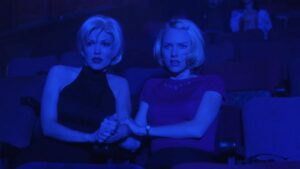
Increasingly, however, the dream reality now dissolves, which is expressed in the blurring images and shaky camera movements on the way to Club Silencio. The visit to Club Silencio is a sequence rich in meaning from which, with regard to my interpretation, we can gather that Diane becomes aware of being in a dream. Thereupon the blue box appears in Betty's handbag. This box is the portal into reality, and soon afterward we are where I began: “Hey pretty girl, time to wake up!” What had been repressed or transferred in the dream is now ugly, cruel reality. In the flashbacks we now see all the disappointments from which the dream wishes arose. At the end the camera finds its way around the corner again to the horror at Winkie's diner: the reality of her own failure and of the murder, embodied by the monster by the dumpsters. We remember what the man said in the nightmare: “He's the one who's doing it!” The entire dream was a striving away from the influence of this truth: the truth that Diane has fallen completely, and that Camilla is now dead. That is why the monster was not simply part of the dream but exists deep in Diane's psyche. From its blue box the monster unleashes concentrated suffering upon Diane. She once raved with the old couple about her future success: they embody, as I said, the disappointed superego, which now, as punishment for her failure and her crime, haunts her in a frenzy and finally drives her to suicide. Last of all we see, superimposed, the face of the monster, the stage of Club Silencio, which symbolizes the dream state, and the two women as bright, happy projections, as pure surfaces on the glittering facade of Los Angeles. The dreamer and her longed-for double, united at last.
These final scenes are not only the tragic end of the character Diane Selwyn; they are also a settling of scores with Hollywood. The supposed dream factory is a nightmare factory. For Hollywood in Lynch's vision is driven by the fear of one's own failure: “He's the one who's doing it!” The Californian La La Land promises success and invites you to dream of passion and success. But these sunny promises quickly turn into an accusing and terrorizing grimace when failure sets in. That the monster of Mulholland Drive is, according to the credits, a homeless man opens up a socially critical dimension of the film. The gleaming palace of the American West hides the victims it itself demands: one and a half million homeless people live in the US; countless lives that have been left behind and have failed, whose American Dream has not come true — failed lives like Diane's. But these people are pushed out of sight; they have no voice in glamorous Hollywood. They find themselves deep in society's Silencio.